Inside the AMR Revolution: Real Warehouses, Real Numbers, and What Logistics Leaders Need to Know
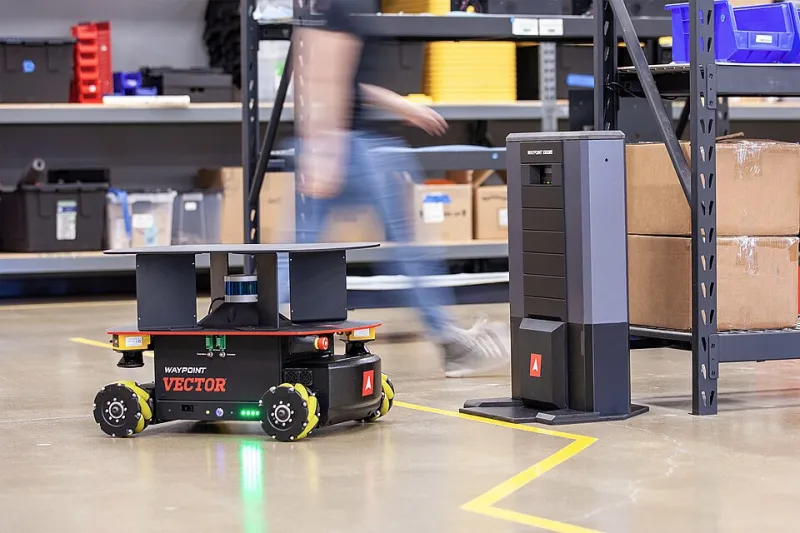
Photo: PattyK33, CC BY-SA 4.0, via Wikimedia Commons
The American warehouse is undergoing its most significant transformation in decades. Driven by relentless e-commerce growth, persistent labor shortages, and the demand for faster fulfillment cycles, facility operators across the country are turning to autonomous mobile robots — commonly referred to as AMRs — to close the gap between what human workforces can deliver and what the market now demands. Unlike their predecessor technology, automated guided vehicles (AGVs), AMRs navigate dynamically using onboard sensors and machine learning, eliminating the need for fixed tracks or magnetic tape. That flexibility has proven to be a decisive advantage in real-world environments.
At Polsinelli Drones & Robots, we track autonomous technology across both aerial and ground-based platforms. The AMR sector has matured rapidly, and the deployment data emerging from U.S. facilities offers a compelling — and nuanced — picture of what this technology can and cannot do today.
A Sector in Acceleration
The U.S. AMR market was valued at approximately $2.1 billion in 2023 and is projected to grow at a compound annual rate exceeding 20% through the end of the decade, according to multiple industry analyses. The primary drivers are well-documented: warehouse labor turnover rates in the U.S. frequently exceed 40% annually, recruiting and training costs are substantial, and wage pressures continue to intensify in tight labor markets. AMRs do not call in sick, do not require benefits, and can operate across multiple shifts without fatigue-related errors.
But the business case for AMR deployment rests on more than labor substitution. Facilities that have successfully integrated these systems report measurable improvements in order accuracy, throughput velocity, and floor space utilization — outcomes that compound over time.
Case Study: Goods-to-Person Fulfillment in a Midwest Distribution Center
One of the more thoroughly documented AMR implementations in recent years involves a mid-sized consumer goods distributor operating a 250,000-square-foot facility in Ohio. Prior to deploying a fleet of 40 AMRs from a leading U.S.-based robotics provider, the facility processed approximately 1,800 orders per day during peak periods, relying heavily on manual pick-and-carry workflows.
Following a phased AMR deployment over six months, the facility reported:
- Order throughput increased to 3,200 units per day during equivalent peak periods — a 78% improvement.
- Pick accuracy improved from 97.2% to 99.6%, reducing returns processing costs by an estimated $180,000 annually.
- Labor reallocation allowed the facility to redeploy 22 floor associates to higher-value roles in quality control, exception handling, and outbound verification rather than eliminating positions outright.
- ROI was achieved within 26 months of full deployment, factoring in hardware, software licensing, integration, and training costs.
The total system investment, including infrastructure modifications and a warehouse management system (WMS) integration, was approximately $2.4 million. The annual operating savings — primarily in labor efficiency gains and error reduction — were calculated at approximately $1.1 million, yielding the sub-30-month payback period.
Case Study: Manufacturing Intralogistics on the East Coast
A Tier 1 automotive components manufacturer in South Carolina deployed AMRs to handle internal material transport between production cells — a use case distinct from traditional order fulfillment but equally compelling. The facility had been relying on a combination of forklifts and manual carts to move subassemblies across a 180,000-square-foot production floor, a workflow that introduced both safety risks and scheduling inefficiencies.
A fleet of 18 AMRs, configured for tow-behind cart transport, was integrated over a four-month period. Key outcomes included:
- Forklift incidents dropped by 64% in the first year, reducing workers' compensation exposure and insurance costs.
- Production line downtime attributable to material delays decreased by 31%, a figure that translated directly into improved on-time delivery performance for Tier 1 contracts.
- Floor space previously allocated to staging areas was partially reclaimed, enabling the addition of a new production cell without a facility expansion.
The safety and productivity gains in this deployment were arguably as significant as the direct labor savings — a reminder that AMR value propositions extend well beyond headcount reduction.
Which Industries Are Seeing the Strongest Returns?
While AMRs have found application across a broad range of sectors, deployment data consistently points to several industries where the technology delivers the most compelling returns:
E-commerce and third-party logistics (3PL): High SKU counts, variable order profiles, and extreme peak-season pressure make these environments natural fits for flexible AMR deployments.
Pharmaceutical distribution: Stringent accuracy requirements and the high cost of errors create strong economic incentives for automation. Temperature-controlled environments add complexity but do not preclude AMR use.
Food and beverage: Repetitive pallet movement, cold storage applications, and the physical demands placed on human workers make this sector increasingly receptive to AMR integration.
Automotive and aerospace manufacturing: Intralogistics complexity, just-in-time delivery requirements, and safety considerations align well with AMR capabilities.
Deployment Challenges Decision-Makers Must Anticipate
No technology assessment is complete without an honest accounting of friction points. AMR implementations that underperform their projections typically share a handful of common failure modes.
WMS and ERP integration complexity is the most frequently cited obstacle. AMRs do not operate in isolation — they must communicate with existing warehouse management and enterprise resource planning systems. Integration timelines are routinely underestimated, and facilities with legacy software infrastructure face the steepest challenges.
Floor condition and facility layout matter more than many buyers anticipate. Uneven concrete, narrow aisles, inconsistent lighting, and cluttered pathways can all degrade AMR performance. Pre-deployment facility assessments are essential and should be treated as non-negotiable.
Workforce transition management is often underfunded. Even in deployments where net employment is maintained or increased, the nature of work changes significantly. Facilities that invest in retraining and transparent communication consistently report smoother transitions and better long-term outcomes.
Scalability planning deserves early attention. AMR fleets can be expanded incrementally, which is one of their key advantages over traditional automation. However, network congestion, charging infrastructure, and fleet management software must be planned for at the outset to avoid costly retrofits.
What to Evaluate Before Committing
For operations leaders approaching an AMR decision for the first time, the evaluation framework matters as much as the technology itself. Key questions to work through before engaging vendors include:
- What specific workflows are you automating? Goods-to-person picking, pallet transport, sortation, and inventory counting each favor different AMR architectures.
- What is your existing technology stack? WMS compatibility and API availability should be evaluated early.
- What does your facility's physical environment look like? Commission a professional site assessment before issuing any RFPs.
- What is your realistic payback threshold? Most deployments achieve ROI in 18–36 months. If your financial model requires faster returns, examine your assumptions carefully.
- Which vendors offer proven deployments in your specific industry vertical? Reference checks with comparable facilities are invaluable.
The Maturity Assessment
AMR technology in 2024 is firmly in the early mainstream phase of adoption — past the experimental stage, but still evolving rapidly. Navigation algorithms, fleet management software, and human-robot collaboration protocols are all advancing on compressed timelines. Facilities deploying today benefit from a more mature ecosystem than those who adopted three years ago, with better vendor support, more integration options, and a larger pool of experienced implementation partners.
For decision-makers who have been monitoring the space from the sidelines, the data increasingly suggests that the question is no longer whether AMRs deliver measurable value — it is whether your organization is positioned to capture it effectively. The facilities that are building that capability now are establishing operational advantages that will compound for years to come.
