Automation's Broken Promise: Why So Many Commercial Robotics Deployments Collapse Before They Deliver
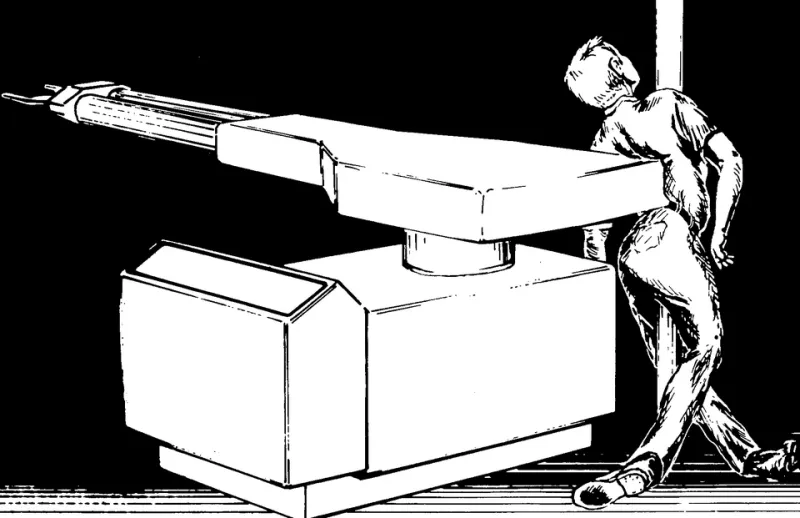
Photo: U.S. National Institute for Occupational Safety and Health, Public domain, via Wikimedia Commons
The sales pitch for industrial robotics has never been more polished. Vendors arrive with detailed ROI models, reference deployments at recognizable companies, and projections that make the capital outlay look almost conservative. Eighteen months later, a troubling number of those same deployments are either underperforming materially against projections or have been quietly abandoned — machinery idled, software subscriptions canceled, and integration teams disengaged.
This outcome is more common than the industry's marketing apparatus would suggest. Conversations with manufacturers, systems integrators, and operations executives across the US reveal a consistent pattern: the technology frequently works as advertised, but the deployment doesn't. The distinction matters enormously, because it points the diagnosis — and the remedy — toward organizational and process factors that vendor selection alone cannot address.
The 18-Month Window and Why It's Critical
Industry observers who track automation project outcomes have noted a particular concentration of failures within the first 18 months of deployment. This window is significant because it typically encompasses the transition from vendor-supported commissioning to independent operational management, the period during which the real-world complexity of integration with existing systems becomes fully apparent, and the point at which the workforce adjustments promised in the business case either materialize or don't.
A robotics integrator with extensive experience across Midwest manufacturing clients described the pattern bluntly: "The first 90 days are usually fine because the vendor's implementation team is still on-site. The problems start when they leave and the client's team has to own the system. If you haven't built that internal capability during commissioning, you're going to struggle."
That observation captures something important. Robotics deployments are not equipment purchases in the conventional sense. They are operational transformations that require ongoing technical ownership, and organizations that treat them as the former while neglecting the latter are setting themselves up for the failure cycle.
Failure Pattern One: The Projection Gap
The most consistent precursor to a failed deployment is an ROI model that was never stress-tested against operational reality. Vendor-provided projections are built on best-case assumptions: optimal uptime, seamless integration with existing ERP and warehouse management systems, and a workforce that adapts smoothly to changed workflows. Each of those assumptions carries risk that is rarely quantified in the initial proposal.
Uptime projections are particularly susceptible to optimism. Published specifications for autonomous mobile robots (AMRs) and collaborative robots (cobots) may cite 95 percent or higher availability rates. In practice, unplanned downtime for software updates, sensor recalibration, and integration troubleshooting routinely pushes first-year effective uptime below 80 percent for complex deployments. On a system justified by labor cost displacement, that 15-point gap can eliminate the entire projected margin.
Operations managers who have navigated failed deployments consistently describe a moment of recognition — usually around month six — when the actual performance data makes clear that the project will not deliver the promised returns on the original timeline. What happens next often determines whether the deployment recovers or collapses: organizations with strong internal champions and executive commitment tend to diagnose and adapt; those without them tend to reduce support, defer maintenance, and accelerate toward abandonment.
Failure Pattern Two: Integration Complexity Underestimated
Robotics vendors sell platforms. They do not sell integrations with the specific combination of legacy ERP systems, custom warehouse management software, aging conveyor infrastructure, and idiosyncratic facility layouts that characterize most real US manufacturing and logistics operations.
The integration gap is where many deployments encounter their most damaging friction. A food and beverage manufacturer in the Southeast attempting to deploy AMRs in a mixed-temperature facility discovered that their existing WMS could not communicate effectively with the fleet management software without a middleware layer that had not been scoped or budgeted in the original project. The six-month delay required to resolve the integration architecture consumed a substantial portion of the projected first-year labor savings before a single productive hour had been logged.
This scenario — integration complexity that was either not surfaced during vendor evaluation or was acknowledged but not adequately resourced — recurs across industries and platform types. Experienced integrators recommend that organizations budget integration work as a separate line item, engage their internal IT and operations teams in technical due diligence before contract signing, and require vendors to document specific integration requirements for the client's existing technology stack rather than accepting generic compatibility claims.
Failure Pattern Three: Change Management as an Afterthought
Perhaps the most consistently underestimated factor in robotics deployment failures is the human element. Automation projects displace, restructure, or fundamentally change a significant portion of the roles in an affected operation. The workforce that will work alongside the new systems — or be redeployed because of them — is also the workforce responsible for operating and maintaining those systems effectively.
Organizations that communicate poorly about automation plans, fail to invest in retraining, or allow anxiety about job security to fester without honest engagement predictably encounter resistance that manifests in subtle but damaging ways: maintenance protocols not followed, system errors not reported promptly, workarounds developed that undermine automation logic, and institutional knowledge withheld from the technical teams trying to optimize performance.
A systems integrator working primarily with automotive suppliers in the Great Lakes region noted that the deployments with the strongest outcomes almost universally shared one characteristic: a designated internal champion at the floor supervisor or operations manager level who was invested in the project's success and trusted by the workforce. "When that person exists and is empowered, problems get surfaced and solved. When they don't, problems get buried until they become crises."
A Diagnostic Framework for Evaluating Robotics Investments
For organizations currently evaluating automation investments, the failure patterns described above suggest a practical pre-commitment diagnostic. Before signing a contract, decision-makers should be able to answer the following questions with specificity rather than approximation.
Integration readiness: Has your IT team reviewed the vendor's API documentation and confirmed compatibility with your current systems? Is middleware required, and if so, who is responsible for developing and maintaining it?
Uptime assumptions: What does the vendor's SLA actually guarantee, and what is the financial model's sensitivity to a 10 or 15 percent reduction in effective uptime during year one?
Internal ownership: Who within your organization will own technical responsibility for this system after the vendor's implementation team disengages? Do they currently have the skills required, and if not, what is the training plan?
Change management investment: What is the communication plan for affected workers? What retraining resources have been budgeted, and over what timeline?
Milestone accountability: What are the specific, measurable performance benchmarks at 90 days, six months, and 12 months, and what are the contractual remedies if they are not met?
Organizations that cannot answer these questions before committing capital are not ready to deploy — regardless of how compelling the vendor's ROI model appears.
The Path to Deployments That Last
The commercial robotics industry is maturing, and the failure rate of early deployments has produced a body of hard-won knowledge that is gradually improving outcomes. Integrators with strong track records are increasingly insisting on pre-deployment readiness assessments, phased implementation structures, and explicit change management components as conditions of engagement — not because they enjoy adding complexity, but because they have learned what the failure patterns cost.
For businesses evaluating automation, the most valuable question to ask a prospective vendor or integrator is not what their best deployments look like, but what their failed ones have in common. The candor and specificity of the answer will reveal more about whether that partner is equipped to navigate the real challenges of implementation than any reference list or case study ever will.