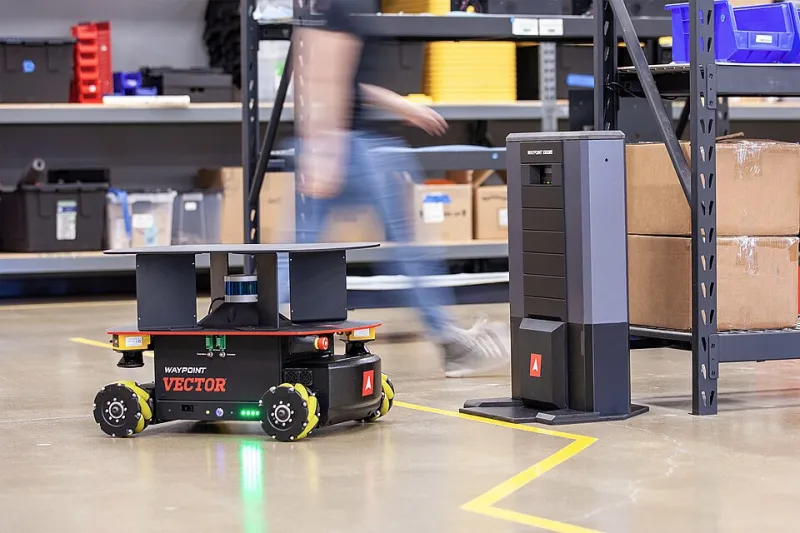
Beyond "Stop": How Next-Generation Sensors Are Redefining Autonomous Robot Safety
For decades, industrial robot safety was largely a matter of physical separation. Keep humans out of the robot's operating envelope, and the risk equation becomes manageable. Cages, light curtains, and pressure-sensitive floor mats enforced that boundary with mechanical reliability. The logic was sound precisely because the robots themselves had no meaningful awareness of the world beyond their programmed motion paths.
That paradigm is eroding. As autonomous mobile robots proliferate across warehouse floors, construction sites, and hospital corridors, and as commercial drones begin operating in increasingly complex airspace, the industry is confronting a more difficult question: what does it mean for a machine to truly perceive its environment—and to act on that perception intelligently?
The answer is being written in sensor data, and the implications extend well beyond the factory floor.
The Hierarchy of Spatial Awareness
Not all sensing technologies are created equal, and understanding their respective strengths illuminates why sophisticated autonomous systems typically rely on sensor fusion rather than any single modality.
LiDAR (Light Detection and Ranging) has become the benchmark for high-fidelity spatial mapping. By emitting rapid pulses of laser light and measuring return times, LiDAR units generate dense three-dimensional point clouds that capture the geometry of a scene with centimeter-level precision. Modern solid-state LiDAR modules—increasingly affordable due to automotive industry investment—can generate millions of data points per second, enabling real-time environmental reconstruction at ranges exceeding 100 meters in some configurations.
For ground-based autonomous robots, LiDAR excels at detecting static obstacles and constructing accurate maps for path planning. Its primary limitation is performance degradation in adverse weather conditions: heavy rain, fog, and airborne particulates scatter laser pulses in ways that reduce effective range and introduce noise into point cloud data.
RGBD Cameras (RGB-Depth) combine conventional color imaging with per-pixel depth measurement, typically achieved through structured light projection or time-of-flight sensing. These devices offer a richer semantic layer than LiDAR alone—a camera can distinguish a stationary cardboard box from a moving person in ways that a point cloud cannot, particularly when paired with modern computer vision models. The tradeoff is reduced range and greater sensitivity to lighting conditions. RGBD cameras perform exceptionally well in controlled indoor environments, which makes them a natural fit for warehouse AMRs and collaborative manufacturing robots.
Millimeter-Wave Radar occupies a complementary niche. Operating in the 24 GHz to 77 GHz frequency range, mmWave radar systems measure both distance and the radial velocity of detected objects through Doppler shift analysis. This velocity awareness is a critical capability that LiDAR and cameras cannot easily replicate in real time. A radar-equipped system can determine not only that an object is present, but how fast it is moving and in which direction—enabling predictive avoidance maneuvers rather than purely reactive stops. Crucially, radar maintains its performance in rain, dust, and low-light conditions where optical sensors struggle.
From Reactive to Predictive: The Architecture of Intelligent Avoidance
First-generation collision avoidance was fundamentally reactive. A proximity sensor detects an object within a defined safety zone; the robot halts. This approach is safe in a binary sense, but it is also brittle. A system that can only stop cannot navigate around a slow-moving pedestrian, yield appropriately to a forklift with right-of-way, or recognize that a partially occluded object in a doorway is a person about to step forward.
The shift toward genuine autonomy requires layering perception, prediction, and planning. Modern autonomous systems increasingly employ architectures in which fused sensor data feeds into machine learning models trained to classify objects, estimate their trajectories, and assign probabilistic risk scores to potential future states. A warehouse robot equipped with this capability does not merely detect a worker walking parallel to its path—it anticipates where that worker will be in two seconds and adjusts its own velocity and heading proactively.
This predictive capacity is what separates collision avoidance from autonomous decision-making, and it is the frontier that leading robotics manufacturers are actively competing to occupy.
Regulatory Frameworks Struggling to Keep Pace
The standards landscape governing autonomous robot safety in the United States reflects the technology's rapid evolution—and the institutional lag that inevitably accompanies it.
For industrial ground robots, ISO 10218 and its US-adopted equivalent ANSI/RIA R15.06 establish foundational safety requirements for robot design and integration. The more recently developed ISO/TS 15066 addresses collaborative robot (cobot) applications specifically, defining force and speed limits for human-robot contact scenarios. However, these standards were developed with fixed-installation robots in mind and are being actively revised to account for mobile, sensor-driven autonomous systems.
The National Highway Traffic Safety Administration (NHTSA) has issued guidance relevant to autonomous ground vehicles operating on public roads, including the voluntary Federal Automated Vehicles Policy framework. While NHTSA's primary jurisdiction covers highway vehicles, its published safety principles—particularly those addressing Operational Design Domain (ODD) definition and system failure response—are increasingly referenced by industrial AMR developers seeking to demonstrate safety rigor.
In the airspace, the FAA's evolving framework for Beyond Visual Line of Sight (BVLOS) drone operations places sensor performance at the center of the regulatory conversation. The agency's BEYOND program and subsequent rulemakings have consistently emphasized that Detect and Avoid (DAA) capability—the aerial equivalent of collision avoidance—must be demonstrated to a quantifiable standard of safety before routine BVLOS operations can be authorized. The FAA's ASTM F3442/F3442M standard for DAA performance is now a key reference document for drone manufacturers pursuing type certification.
The Integration Challenge
Deploying multi-sensor autonomous systems at industrial scale introduces engineering challenges that extend well beyond sensor selection. Calibrating multiple sensing modalities to a common coordinate frame, managing the computational load of real-time data fusion, ensuring system behavior degrades gracefully when individual sensors fail—each of these problems demands careful systems engineering.
Power consumption is a non-trivial constraint for mobile platforms. A high-resolution spinning LiDAR, multiple RGBD cameras, and a radar array draw substantial current, directly reducing the operational runtime of battery-powered AMRs and drones. Solid-state LiDAR designs and increasingly efficient inference hardware (purpose-built AI accelerator chips from companies such as NVIDIA and Qualcomm) are gradually easing this tension, but it remains an active area of development.
Cybersecurity represents an emerging concern that safety standards are only beginning to address. Sensor systems that transmit data wirelessly or interface with fleet management software introduce attack surfaces that did not exist in the era of cage-isolated industrial robots. As autonomous systems become more networked, the integrity of the data they perceive becomes a safety-critical property.
What This Means for Buyers and Operators
For organizations evaluating autonomous robotic systems today, sensor architecture should be a primary evaluation criterion—not an afterthought. Questions worth asking of any vendor include: What sensor modalities does the system employ, and how are they fused? What is the system's defined Operational Design Domain, and how does it behave at the edges of that domain? What certifications or third-party safety assessments has the platform undergone?
The robots and drones that will define the next decade of industrial automation are not distinguished merely by speed or payload capacity. They are distinguished by how well they see, how accurately they predict, and how intelligently they act in a world that does not hold still. That capability begins—and is ultimately constrained—by the quality of the sensors at their core.