Stranded by Insolvency: What Drone and Robotics Operators Must Do When a Manufacturer Disappears

The contract looked solid. The service agreement covered two years of firmware updates, priority hardware support, and a dedicated account representative. Then, without much warning, the manufacturer's website went dark, the support line disconnected, and a Chapter 7 filing appeared in federal bankruptcy court. Suddenly, a fleet of commercial drones worth six figures became little more than expensive paperweights.
This scenario is not hypothetical. As the commercial drone and robotics sectors continue to mature, a wave of consolidation and capital exhaustion is claiming companies that once appeared well-positioned. For operators who staked their business continuity on a single manufacturer relationship, the consequences can be severe. Understanding what happens legally, operationally, and financially when a manufacturer goes under is no longer optional knowledge—it is a baseline requirement for anyone running a serious autonomous technology operation.
The Collapse Cycle: Why Drone and Robotics Companies Fail
The autonomous technology industry has attracted enormous venture capital over the past decade, and with that capital came aggressive product launches, ambitious roadmaps, and expansion timelines that frequently outpaced revenue reality. When funding rounds slow or market adoption lags projections, manufacturers that depend on continued investment rather than sustainable margins become vulnerable quickly.
The pattern tends to follow a recognizable sequence. A company announces a restructuring, then quietly reduces its support staff, then halts firmware development, and finally files for protection under Chapter 7 or Chapter 11 of the US Bankruptcy Code. Operators rarely receive direct notification at any of these stages. Most learn about the filing through industry news or, more commonly, when their service tickets simply stop receiving responses.
The robotics sector has seen this play out with collaborative robot startups, autonomous mobile robot vendors, and drone manufacturers alike. In each case, operators who had diversified across multiple platforms fared considerably better than those who had committed entirely to a single vendor ecosystem.
What Bankruptcy Actually Means for Your Contracts and Warranties
The legal reality of manufacturer bankruptcy is largely unfavorable to operators, particularly in Chapter 7 liquidation cases. Under Chapter 7, a trustee is appointed to liquidate the debtor's assets and distribute proceeds to creditors. Unsecured creditors—which typically includes customers holding service contracts—rank well below secured lenders and administrative claims in the priority hierarchy. In practical terms, this means operators are unlikely to recover meaningful value from outstanding service agreements or warranty obligations.
Chapter 11 reorganization offers a marginally better scenario. In Chapter 11, the manufacturer attempts to restructure its debts and continue operating. Existing contracts may be assumed or rejected by the debtor-in-possession, and operators may have some opportunity to negotiate continuity arrangements. However, the outcome depends heavily on the specific reorganization plan and the leverage the operator holds.
Warranties present a particular vulnerability. In most jurisdictions, product warranties are treated as general unsecured claims in bankruptcy proceedings. Unless a warranty has been backed by a third-party insurer or a dedicated escrow arrangement, operators are unlikely to see those obligations honored. The Federal Trade Commission's Magnuson-Moss Warranty Act governs consumer warranties but provides limited practical recourse when the warrantor ceases to exist.
For operators holding active service level agreements at the time of filing, the advice from legal counsel is nearly universal: file a proof of claim with the bankruptcy court as promptly as possible, and do not assume that silence from the manufacturer implies the contract remains valid.
The Operational Fallout: Firmware, Parts, and Certification
Beyond the legal dimension, the operational consequences of manufacturer insolvency are often more immediately damaging. Commercial drones and industrial robots are not static hardware. They depend on ongoing firmware updates for regulatory compliance, safety patches, and functional performance. When a manufacturer disappears, that update pipeline ends entirely.
For operators subject to FAA Part 107 requirements or those seeking BVLOS waivers, firmware currency can be a material factor in compliance standing. Equipment running deprecated software may face additional scrutiny during operational audits or incident investigations. Operators should document their firmware version history and consult with aviation legal counsel if compliance questions arise following a manufacturer failure.
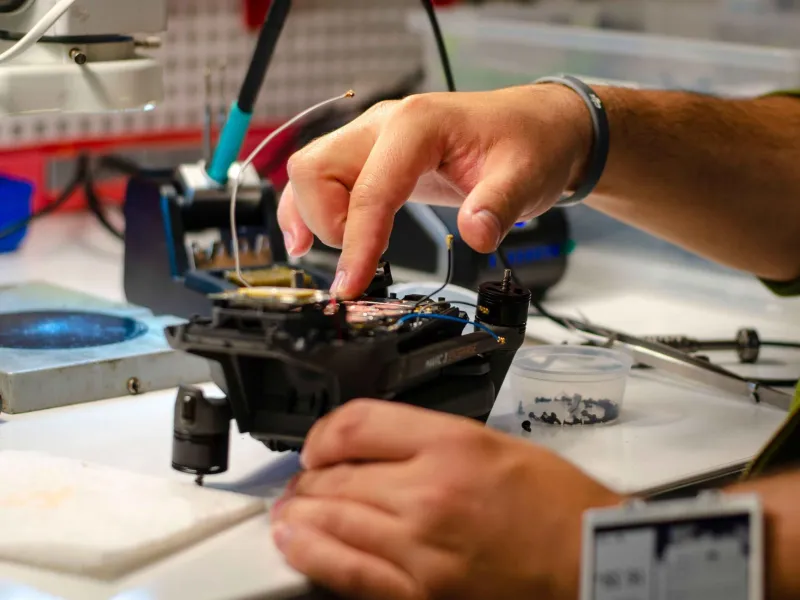
Replacement parts present an equally serious challenge. Proprietary components—battery management systems, gimbal assemblies, specialized sensors—are often unavailable through any channel once the original manufacturer ceases production. Secondary market sources can emerge over time, but quality and compatibility are never guaranteed. Operators who had the foresight to maintain a spare parts inventory at the time of collapse typically experienced far shorter operational disruptions than those who relied on just-in-time procurement.
For robotics deployments, the integration layer adds another layer of complexity. Industrial robots embedded in production workflows often depend on proprietary software interfaces, calibration tools, and communication protocols. When those tools become inaccessible, even technically capable maintenance teams may find themselves unable to service equipment they physically possess.
Protective Strategies Before the Crisis Arrives
The most effective response to manufacturer insolvency is one that begins long before any signs of financial distress appear. Operators who treat vendor financial health as an ongoing due diligence responsibility—rather than a one-time evaluation at the point of purchase—are far better positioned to respond when conditions deteriorate.
Several practices deserve consideration as standard operating procedure.
Vendor financial monitoring. Operators making significant capital commitments to a single manufacturer should request audited financial statements or, at minimum, review publicly available filings if the company is publicly traded. Private companies are not required to disclose financial data, but significant changes in leadership, investor backing, or market activity can serve as early indicators of instability.
Escrow and source code provisions. When negotiating contracts with manufacturers, operators should request software escrow arrangements that would release firmware source code or proprietary configuration tools to customers in the event of insolvency. While not all manufacturers will agree to such terms, larger procurement contracts often provide sufficient leverage to negotiate them.
Multi-vendor fleet strategy. Concentrating an entire operation on a single manufacturer's platform creates a single point of failure that extends well beyond technology risk. Maintaining operational capability across at least two vendor ecosystems substantially reduces exposure, even if it introduces some complexity in training and maintenance protocols.
Parts inventory planning. Establishing minimum on-hand inventory levels for high-failure-rate components is a practice borrowed from traditional asset-intensive industries and applies directly to drone and robotics operations. The cost of carrying modest surplus inventory is almost always lower than the cost of extended downtime following a supply disruption.
Contract language review. Standard manufacturer agreements are drafted to protect the manufacturer. Operators should engage legal counsel familiar with commercial technology contracts to negotiate provisions addressing bankruptcy scenarios, including assignment restrictions, data portability, and warranty transfer rights.
When the Damage Is Already Done
For operators already holding unsupported equipment following a manufacturer failure, the path forward requires pragmatism. Third-party maintenance providers have emerged as a meaningful resource in several segments of the market, particularly for widely deployed platforms where a sufficient installed base exists to sustain aftermarket service ecosystems. Industry forums and professional associations can be valuable resources for identifying reputable providers.
In some cases, operators have successfully organized collectively to negotiate with bankruptcy trustees for access to intellectual property, documentation libraries, or parts inventories that would otherwise be liquidated. These efforts require coordination and legal representation but have yielded results in select cases.
Finally, operators should evaluate whether their commercial insurance policies include any coverage for business interruption losses attributable to vendor insolvency. Most standard policies do not, but specialty technology operations policies may offer relevant endorsements worth reviewing with a broker.
The autonomous technology sector will continue to consolidate. Some of today's prominent manufacturers will not survive the next market cycle. The operators who navigate that reality most successfully will be those who treated vendor durability as a strategic variable from the beginning—not an afterthought discovered in a bankruptcy filing.