When Backup Becomes a Liability: The Hidden Dangers of Poorly Structured Multi-Pilot Drone Operations
The Assumption That a Second Pilot Automatically Means Safer Skies
The logic seems airtight on the surface: two pilots are better than one. If the primary operator is incapacitated, distracted, or simply makes an error in judgment, a second set of eyes and hands stands ready to intervene. Most commercial drone operations that have grown beyond solo missions have adopted this model without subjecting it to serious scrutiny.
That oversight is costly. Across a range of commercial environments—from infrastructure inspection corridors to large-scale agricultural surveys—backup pilots have been implicated in accidents and near-misses not because they were absent, but precisely because they were present without adequate preparation. The second operator problem is not about having too few pilots. It is about having pilots who are structurally set up to work against each other.
Where the Breakdown Actually Begins
The most common failure point is deceptively mundane: training disparity. Primary operators in commercial settings often accumulate dozens or hundreds of hours on specific platforms, developing an intuitive grasp of how a given aircraft behaves in crosswinds, how its obstacle avoidance system responds near reflective surfaces, or how its battery performance degrades in cold temperatures. Backup pilots, by contrast, frequently have far less platform-specific experience. They may hold a valid Part 107 certificate and have logged meaningful flight hours, but those hours may have been accumulated on entirely different equipment.
When a handoff occurs under pressure—precisely the circumstances in which a backup pilot is most likely to be called upon—that experiential gap becomes a live hazard. The incoming operator may apply inputs calibrated to a different aircraft's handling characteristics, misread a telemetry display they are less familiar with, or hesitate at a moment that demands immediate action.
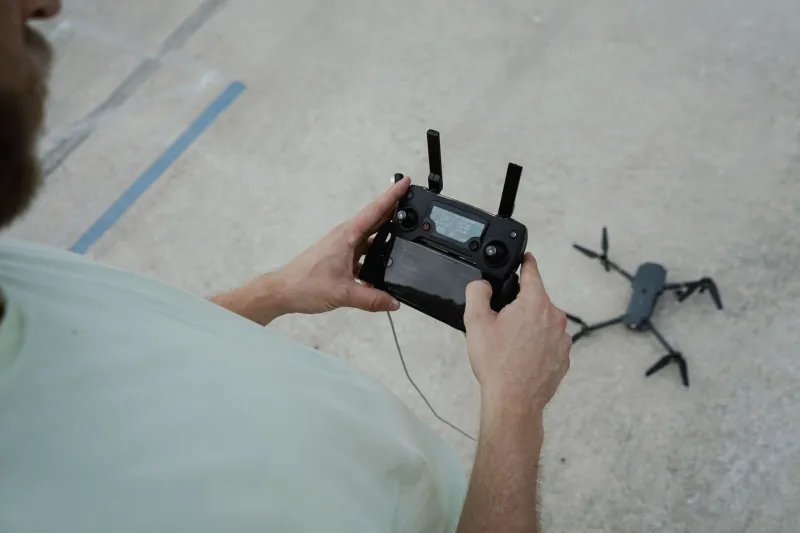
Equally problematic is the absence of formalized handoff protocols. In many commercial operations, the transition from primary to backup pilot is treated as an informal gesture—a verbal acknowledgment, a physical exchange of the controller—rather than a structured procedure with defined checkpoints. There is rarely a standardized confirmation that the incoming operator has situational awareness of current altitude, heading, battery state, and surrounding airspace conditions before assuming control. That informality introduces a window of ambiguity during which neither pilot has clear authority over the aircraft.
Conflicting Risk Assessments: The Invisible Collision
Beyond training and handoff mechanics lies a subtler problem: two pilots may evaluate the same situation and reach fundamentally different conclusions about acceptable risk. One operator may have a conservative threshold for wind gusts that triggers an early return-to-home decision. The other may be more comfortable pushing closer to the aircraft's operational envelope. When these divergent philosophies are never explicitly discussed or resolved before a mission, they create a latent conflict that surfaces at exactly the wrong moment.
This is not merely a matter of personal preference. Differing risk assessments can produce contradictory commands, delayed decisions, and—most dangerously—a situation in which each pilot believes the other is managing a developing problem while neither is actively doing so. Investigators reviewing drone incident reports have identified this dynamic in multiple cases where an aircraft was lost or damaged despite two experienced operators being present on the ground.
Real-World Failure Patterns Worth Examining
Consider a power line inspection operation in which a primary pilot hands off control to a backup during a crew rotation midway through a long corridor. The backup operator, unfamiliar with the specific drift tendency of that aircraft in gusty conditions, fails to apply the corrective trim inputs the primary pilot had been using unconsciously throughout the first half of the mission. The aircraft drifts closer to energized infrastructure than the safety buffer allows. By the time the discrepancy is recognized, the situation has escalated.
Or consider a construction site survey in which the primary and backup pilots have never explicitly discussed how to handle a sudden communication link degradation. When signal quality drops, both operators simultaneously attempt to interpret the situation—one reaching for the controller to initiate a manual override, the other waiting for the failsafe to engage—creating a brief but consequential moment of paralysis.
Neither scenario involves negligence in the traditional sense. Both involve competent, certificated pilots operating within a structural framework that was never designed to handle the specific pressures of a real-time handoff.
Building a Multi-Pilot Framework That Actually Works
The remedy is not to eliminate backup pilots. It is to professionalize the role with the same rigor applied to the primary position.
Standardize platform-specific training for every operator on the team. Backup pilots should log a defined minimum of hours on the exact aircraft types they may be called upon to fly, under conditions that simulate realistic operational stress. Simulator time, where available, should supplement but not replace actual flight experience.
Formalize handoff procedures as written checklists. A structured transition protocol should require the incoming operator to verbally confirm awareness of current flight parameters before assuming control. The outgoing operator should not relinquish the controller until that confirmation is received. This mirrors crew resource management practices long established in manned aviation.
Conduct pre-mission risk alignment sessions. Before any operation involving more than one pilot, the team should explicitly discuss thresholds—for weather, battery state, link quality, and airspace complexity—at which control will transfer and what actions will be taken. Disagreements surfaced during planning are far less dangerous than disagreements surfaced at altitude.
Define command authority unambiguously. At any given moment, exactly one person should hold unambiguous authority over the aircraft. Dual-input situations, even brief ones, are a structural hazard. Operational SOPs should specify how authority transfers and who resolves disputes when pilots disagree during a live mission.
Conduct post-mission reviews that specifically evaluate the handoff. Even when an operation concludes without incident, debriefing the transition moments—what each pilot observed, what decisions were made, and whether they were aligned—builds institutional knowledge and surfaces procedural gaps before they produce consequences.
Rethinking What Redundancy Actually Means
The commercial drone industry has borrowed the concept of redundancy from aerospace and applied it to personnel with less rigor than it applies to hardware. A redundant battery system is tested, rated, and integrated into the aircraft's failure management architecture. A redundant pilot is often simply someone with a certificate and availability.
Closing that gap requires treating the second operator role as a specialized function rather than a generic fallback position. Operators who invest in that elevation—through training, protocol development, and honest pre-mission alignment—will find that their backup pilot genuinely does what the role is supposed to do: reduce risk rather than redistribute it.