Two Pilots, One Mission: The Structural Failures That Undermine Drone Team Operations—and How to Prevent Them
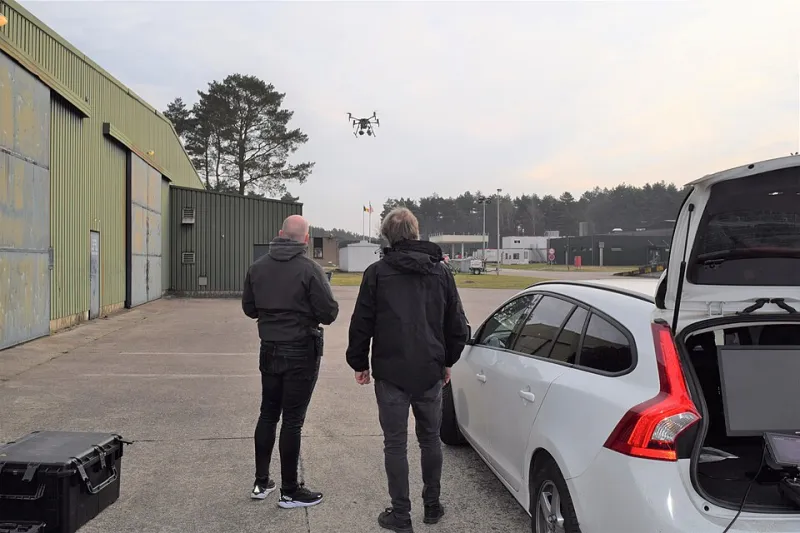
Photo: U.S. Army photo by Sandra Wilson, Public domain, via Wikimedia Commons
The Solo Operator Ceiling
Single-pilot drone operations have a natural efficiency ceiling. One person can manage only so many simultaneous responsibilities: monitoring airspace, managing the aircraft, coordinating with ground contacts, reviewing telemetry, and documenting the mission. For straightforward assignments in uncongested environments, the solo model works well. As mission complexity increases—longer flight times, more demanding sensor configurations, tighter coordination with ground personnel, or operations in restricted airspace—the cognitive and physical limits of a single operator become a genuine constraint.
The intuitive response is to add personnel. Bring in a second pilot, a visual observer, or a dedicated sensor operator, and the workload distributes across more hands. In practice, however, many organizations discover that adding a second person to a drone operation initially makes things worse before making them better. Understanding why that happens is the first step toward building a team structure that actually scales.
Why the Second Operator Problem Exists
The core difficulty is that drone operations, as most commercial operators have developed them, are designed around a single decision-maker. The pilot in command holds all authority, manages all communication, and makes all real-time judgments. Introducing a second person with operational responsibilities creates an authority overlap that, without explicit structural resolution, produces hesitation, redundant communication, and conflicting inputs at the worst possible moments.
This is not a personnel problem. It is a design problem. The same dynamic plays out in aviation, emergency response, and surgical teams when role boundaries are not clearly established before operations begin. In each of those fields, the solution is the same: defined roles, explicit communication protocols, and a hierarchy that resolves ambiguity without requiring negotiation during the mission itself.
Commercial drone operations have been slower to adopt this discipline, partly because the industry grew from a solo practitioner model and partly because the relevant training infrastructure—Part 107 certification, manufacturer courses, most commercial drone curricula—focuses almost exclusively on individual pilot competency rather than team coordination.
Defining Roles Before the First Flight
Effective drone team operations begin with a role architecture that assigns specific responsibilities to specific individuals and establishes clear handoff procedures for situations where those responsibilities interact.
The pilot in command retains ultimate authority over the aircraft and the mission. This is both a regulatory requirement under FAA rules and a practical necessity. What changes in a team context is that the PIC must explicitly delegate certain observational and operational tasks to other team members—and trust those delegations rather than attempting to manage everything simultaneously.
A visual observer's function extends well beyond simply watching the drone. In a well-structured team, the VO is also the primary airspace monitor, responsible for identifying and communicating potential conflicts before they require evasive action. The communication protocol between VO and PIC should be standardized: specific call formats for routine status reports, a distinct call format for immediate hazards, and a clear understanding of which situations require the VO to make a recommendation versus which require an immediate directive.
When a dedicated sensor operator is part of the team—common in thermal inspection, photogrammetry, or multi-spectral agricultural surveys—the division between aircraft management and payload management becomes critical. The sensor operator focuses entirely on data quality, sensor calibration, and coverage verification. The PIC focuses on the aircraft. Neither should be routinely crossing into the other's domain during active operations, though both need sufficient situational awareness to support the other in emergencies.
Liability Division in Multi-Operator Missions
The legal landscape for multi-person drone operations contains ambiguities that many operators have not worked through before they become relevant. Under current FAA regulations, the pilot in command bears primary regulatory responsibility for the operation. That designation does not, however, automatically resolve civil liability questions when an incident involves actions taken by another team member.
If a visual observer fails to call out a hazard that leads to a collision, the PIC remains the named party in FAA enforcement proceedings. In civil litigation, however, the VO's employer, the contracting organization, and potentially the VO individually may all face exposure depending on how the team's roles were documented and how the chain of events unfolded.
Operating under a clear written crew resource management plan—one that documents each team member's assigned responsibilities, qualifications, and the communication protocols in use—provides important protection in both regulatory and civil contexts. This documentation demonstrates that the operation was structured deliberately and that each person's role was defined in advance. Its absence, by contrast, creates an evidentiary gap that opposing counsel will be quick to exploit.
For operations conducted under contract, the agreement itself should address how liability is allocated between the operating company and any subcontracted team members. Assumptions about who bears responsibility for what are not a substitute for explicit contractual language.
Communication Protocols That Actually Work Under Pressure
The most common failure mode in drone team operations is not a technical malfunction—it is a communication breakdown during a time-sensitive situation. Protocols that function adequately during routine operations often collapse when conditions change rapidly.
Borrowing from established aviation crew resource management practices, effective drone teams use closed-loop communication: the receiving party repeats the instruction or information back to confirm accurate receipt before acting. This adds a small time cost to routine communication but dramatically reduces the risk of misunderstood instructions during high-stakes moments.
Briefings before each mission should cover not only the planned operation but also the contingency procedures: what happens if the PIC becomes incapacitated, what the abort criteria are, who has authority to call a mission termination, and how the team communicates with the client or ground contact during the operation. Teams that have rehearsed these scenarios perform significantly better when they occur than teams that encounter them for the first time during an actual mission.
Building Toward Genuine Scalability
The operators who successfully scale beyond solo operations share a common characteristic: they invest in team structure before they need it. They develop crew resource management documentation, train team members together rather than individually, and conduct post-mission debriefs that evaluate team performance alongside aircraft performance.
Adding headcount to a drone operation without this infrastructure does reduce efficiency before improving it—not because the personnel are inadequate, but because the organization hasn't yet built the coordination architecture that converts individual competence into collective capability. That architecture is buildable. It simply requires treating team operations as a discipline in its own right rather than an extension of solo flying.