Where Robots Actually Pay Off: The Counterintuitive Industries Winning at Automation

Photo: alex lines, CC BY-SA 2.0, via Wikimedia Commons
The conventional wisdom on robotics return on investment runs roughly as follows: high-volume, repetitive manufacturing environments are the ideal deployment context, because automation's advantages—speed, consistency, tirelessness—are most valuable where the same task is performed thousands of times per shift. It is a logical argument. It is also, with notable regularity, wrong.
The industries generating the most compelling robotics ROI stories in the current US market are not the obvious candidates. They are specialty food producers, regional textile operations, and mid-sized logistics hubs serving niche distribution networks. Meanwhile, large-volume manufacturers—the theoretical sweet spot for automation—continue to report deployment failures, stalled integrations, and ROI timelines that stretch well past original projections.
Understanding this inversion is not merely an academic exercise. For industrial clients evaluating automation investments, it is the difference between a capital expenditure that transforms operations and one that becomes a cautionary case study.
Why High-Volume Manufacturing Underperforms
The failure of robotics to deliver consistent returns in high-volume manufacturing environments is counterintuitive until you examine the structural conditions that actually determine automation success.
Large manufacturers typically operate with several characteristics that work against robotics ROI. First, they have already optimized their labor costs through scale, shift structures, and industrial engineering disciplines that have been applied over decades. The marginal cost of additional human labor in these environments is often lower than the annualized cost of the robotic system intended to replace it, once integration, maintenance, and reconfiguration expenses are factored in.
Second, high-volume manufacturing environments are frequently characterized by process complexity that is invisible from the outside. A production line that appears to perform a single repetitive task may actually require hundreds of micro-adjustments per shift—adjustments that experienced human workers make unconsciously and that robotic systems handle poorly without expensive sensing and programming investments.
Third, large manufacturers operate under procurement and integration processes that add substantial cost and timeline to robotics deployments. By the time a system is specified, approved, integrated, and validated, the operational environment may have changed enough to require reconfiguration—a cycle that erodes projected returns before the system produces its first unit.
The Hidden Variables That Determine Success
The industries where robotics automation is generating genuine ROI share a different set of structural characteristics—ones that are rarely featured in standard automation feasibility analyses.
Labor scarcity, not labor cost. Small specialty food producers—artisan bakeries, regional condiment manufacturers, specialty confectioners—operate in labor markets where the relevant skills are genuinely scarce, not merely expensive. A regional bakery in a rural Midwestern market may be unable to hire experienced production staff at any wage point. Robotics in this context does not replace cheap labor; it substitutes for labor that cannot be recruited. The ROI calculation is fundamentally different, and far more favorable.
Regulatory cost as a multiplier. Specialty textile operations and food producers operate under regulatory regimes—FDA food safety rules, textile labeling requirements, workplace safety standards—that impose compliance costs that scale with human headcount. Reducing the number of workers involved in specific production stages reduces regulatory exposure in ways that standard ROI models do not capture. One specialty textile producer in the Carolinas reported that automation of its dyeing line reduced not only labor costs but OSHA compliance overhead and wastewater regulatory burden simultaneously—a combined saving that made the deployment economics work despite production volumes that would have been dismissed as too low for conventional automation analysis.
Process standardization at the task level, not the product level. Counterintuitively, the relevant unit of standardization for robotics is not the product but the task. A regional logistics hub handling dozens of different SKUs for niche retail clients may appear to be a poor automation candidate because of product variety. But if the physical handling task—picking, packing, labeling—is standardized across that variety, a collaborative robot system can address it effectively. The mistake most analysts make is treating product diversity as a proxy for task diversity. They are not the same thing.
Case Profiles: Where the Math Actually Works
Several deployment patterns in the current US market illustrate these dynamics.
A specialty bakery operation in the Pacific Northwest deployed a collaborative robotic arm for dough portioning and tray loading—tasks that required consistent force application and were causing repetitive strain injuries among human workers. The operation ran two shifts with a combined staff of eleven. Automation of two workstations reduced injury-related workers' compensation costs by 40 percent in the first year, a saving that was not modeled in the original ROI projection but that materially improved the actual return. The system paid back its capital cost in twenty-two months.
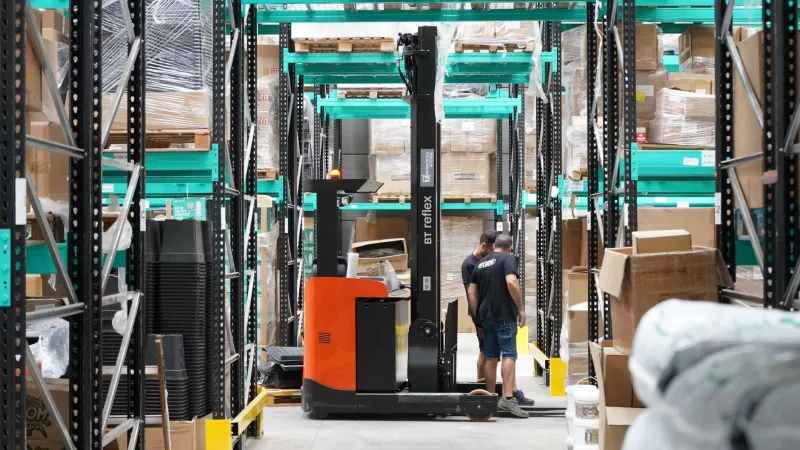
A regional logistics hub in the mid-Atlantic states serving specialty retail clients deployed autonomous mobile robots for intra-warehouse transport. The operation handled low volumes by large-distribution-center standards but faced severe labor turnover—a problem endemic to its geographic market. The AMR deployment reduced dependence on a workforce segment with annual turnover exceeding 80 percent, eliminating the continuous recruiting and training costs that had been suppressing margins for three consecutive years. ROI was achieved in eighteen months.
In contrast, a high-volume plastics manufacturer in the Southeast invested in a robotic assembly line intended to replace a twelve-person shift. Integration costs ran 60 percent over budget. Process variability in incoming material—variability that human workers had been compensating for without formal documentation—required eighteen months of reprogramming after deployment. The system eventually reached design throughput, but at a total cost that extended the payback period to nearly six years.
A Diagnostic Framework Before You Invest
For industrial clients evaluating robotics investments, the following questions are more predictive of success than standard volume and unit-cost analyses:
- Is the labor problem a cost problem or a scarcity problem? If you cannot hire the workers you need, automation economics are more favorable than if you are simply trying to reduce a wage bill.
- Does your regulatory environment impose per-headcount compliance costs? If yes, model those savings explicitly.
- Is the task standardized, even if the product is not? Assess the physical handling requirements of your process independent of product variety.
- What is your true integration cost, including internal engineering time and process revalidation? Most organizations undercount this by a factor of two.
- What is your tolerance for a longer-than-projected payback period? Honest answers to this question eliminate deployments that look good on paper but will be politically unsustainable if they run over schedule.
The automation opportunity is real. But it is not uniformly distributed across industries in the way that conventional analysis suggests. The operators and manufacturers who approach robotics investment with a clear-eyed diagnostic process—rather than category assumptions—are the ones generating returns that justify the capital commitment. The rest are building case studies in what not to do.